How to Write a Runbook Your IT Team Will Actually Use
A good runbook turns a 2 a.m. scramble into a calm sequence of known steps. Here's how to write one your team will actually reach for — and keep current.
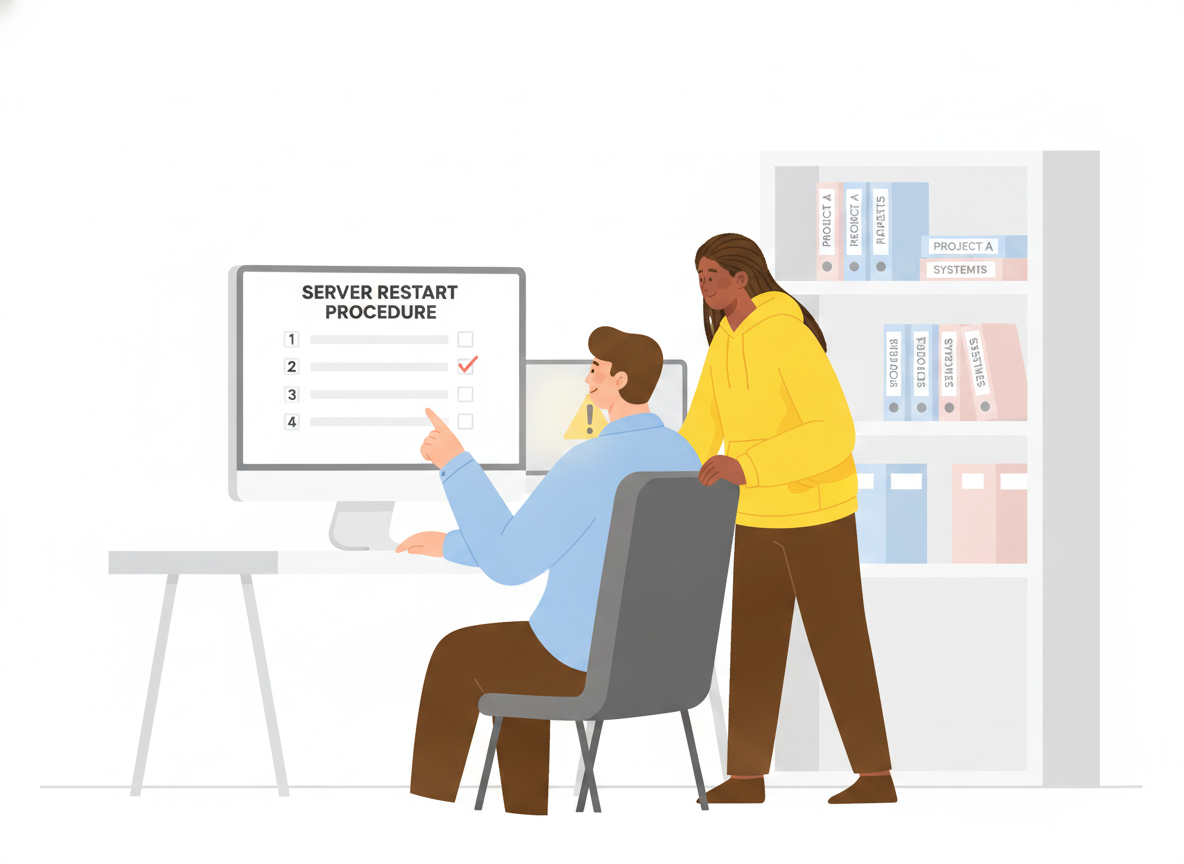
It's 2 a.m. A payment service is throwing errors, the alert has paged whoever is on call, and the one engineer who really understands that system is asleep, on vacation, or no longer at the company. What happens next depends almost entirely on one thing: whether someone wrote down how to handle this.
That "how to handle this" document is a runbook. A good one turns a stressful, improvised scramble into a calm sequence of known steps — and it shortens the time it takes to get the service healthy again. This guide walks through what a runbook is, how it differs from related documents, what separates a useful runbook from a neglected one, and how to write and maintain runbooks your team will actually reach for.
What is a runbook?
A runbook is a step-by-step set of operational instructions for completing a specific task or responding to a specific situation — restarting a stuck service, rotating a certificate, recovering a failed database, or working through a particular alert. It captures the knowledge in one person's head as a procedure anyone on the team can follow.
The point of writing it down is reliability. Google's Site Reliability Engineering teams have long observed that pre-written guidance reduces stress, lowers the mean time to repair (MTTR), and cuts the risk of human error during an incident, compared with figuring things out from scratch each time. When the steps already exist, the responder spends their energy on judgment, not on rediscovery.
Runbook vs. playbook vs. SOP
These three terms get used interchangeably, which causes real confusion. They are related but distinct:
- Runbook — narrow and tactical. One task or one scenario, written as a concrete sequence of actions: "the disk is full, here is exactly what to check and do."
- Playbook — broader and strategic. It coordinates a whole class of events — a security breach, a major outage — covering roles, communication, escalation, and decision-making, often pointing to several runbooks along the way.
- Standard operating procedure (SOP) — the formal, often compliance-driven description of how a recurring process should be done. SOPs lean toward policy and consistency; runbooks lean toward execution under pressure.
A simple way to remember it: a playbook decides what to do and who does it, a runbook tells you how to do one piece of it, and an SOP records the agreed standard so everyone does it the same way.
What makes a good runbook
Most runbooks fail not because they're missing, but because they can't be trusted in the moment. Strong runbooks share a few traits:
- Actionable. Each step is a concrete action, not a paragraph of background. The reader should be able to do, not interpret. Where a single command does the job, give the exact command.
- Accurate. Nothing erodes trust faster than a runbook whose first step already fails. An out-of-date runbook is worse than none, because it sends a tired responder down a dead end.
- Accessible. It should be findable in seconds and readable on a phone at 2 a.m. Every tool reference should include its direct link, every dashboard its exact URL, every credential a pointer to where it's stored — not a vague "log into the admin panel."
- Linear, not a maze. Write a straight sequence of steps. If the situation genuinely branches, split it into separate runbooks and link between them rather than nesting decision trees that are hard to follow under stress.
- Owned by a team, not a person. People change roles and leave; teams persist. Assign each runbook to the team responsible for the system so there's always someone accountable for keeping it current.
How to write a runbook, step by step
You don't need a heavy process to start. You need to capture what your best responder already does. Here is a practical sequence.
1. Pick a real, recurring scenario
Start where the pain is. The UK's National Cyber Security Centre advises building documented response guidance for your top three to five risks first, rather than trying to cover everything at once. Look at your alert history and your most common incidents, and write the runbook for one of them.
2. Capture the steps as someone actually performs them
The most accurate runbook is written while the task is being done. Sit with the person who knows the system and record each action in order — the command they run, the dashboard they check, the threshold that tells them it worked. Resist the urge to clean it up into theory; you want the real path.

3. Give the runbook a clear structure
A reliable template includes:
- Title and purpose — the exact scenario this covers, in one line.
- When to use it — the trigger or alert that should send someone here.
- Prerequisites and access — what tools, permissions, and links the responder needs before they start.
- Numbered steps — the ordered actions, each with the expected result.
- Verification — how to confirm the issue is resolved.
- Escalation — who to contact, and the criteria for escalating, if the steps don't work.
4. Write for the tired, unfamiliar reader
Assume the person reading it is stressed and has never done this task before. Use plain language and short sentences. Spell out anything you'd normally assume. If a step is risky or irreversible, flag the warning before the step, not after.
5. Test it with someone who didn't write it
A runbook is a hypothesis until someone else follows it successfully. Hand it to a teammate and have them work through it — ideally in a drill, not a real incident. The gaps they hit are exactly the gaps that would have cost you time at 2 a.m. NIST's incident-handling guidance makes the same point about plans in general: the act of writing and rehearsing them is what reveals the holes in your response capability.
Keep it alive: the maintenance problem
The hardest part of runbooks isn't writing them — it's keeping them true. Google's SRE practice puts it bluntly: the details in operational guides go out of date at the same rate your systems change. A runbook written six months ago and never touched is a liability waiting for a bad night.
Build maintenance into the work itself:
- Update on use. When someone follows a runbook during an incident and finds a step wrong or missing, they fix it then and there — while the gap is fresh.
- Review on a cadence. Tie a light review to system changes or a recurring calendar reminder, so ownership is real and not aspirational.
- Capture lessons after incidents. Post-incident reviews are the natural moment to ask, "did the runbook hold up?" and feed the answer back in. Keeping that record also matters for audits — documented, testable response processes are exactly what frameworks like SOC 2, ISO 27001, and emerging regulations expect you to show.
- Automate the rote parts. When a runbook becomes a fixed list of identical commands, that's a signal to script it. Let automation handle the deterministic steps and reserve the runbook for the judgment that still needs a human.
Where your runbooks should live
A runbook only helps if the responder can find it in seconds, trust that it's current, and read it on whatever device is in front of them. That argues for a single, searchable home rather than a scatter of wiki pages, buried documents, and personal notes — a single source of truth where every runbook is versioned, easy to update, and accessible to the whole team.
This is exactly the kind of operational documentation Sonat is built to hold: clear, searchable, mobile-friendly docs that non-technical and technical teammates alike can keep current, with version history so you can see what changed and restore an earlier version if a step turns out wrong. When your runbooks live somewhere people actually look — and trust — they stop being shelfware and start saving you time on your worst night.
The takeaway
A runbook is a small investment that pays off precisely when everything else is going wrong. Start with your most common incident, capture the steps as your experts really perform them, structure them so a tired stranger could follow along, test them before you need them, and — most important — keep them alive. The teams that resolve incidents calmly aren't the ones with the most heroes; they're the ones who wrote down what the heroes know.